การประยุกต์ใช้ WQI และ WPI สำหรับประเมินคุณภาพน้ำลุ่มน้ำบางปะกง
Article Sidebar
Main Article Content
Abstract
Pachoenchoke Jintasaeranee and Bhumiphat Pachana
รับบทความ: 12 กุมภาพันธ์ 2568; แก้ไขบทความ: 11 มีนาคม 2568; ยอมรับตีพิมพ์: 23 มีนาคม 2568; ตีพิมพ์ออนไลน์: 4 มิถุนายน 2568
บทคัดย่อ
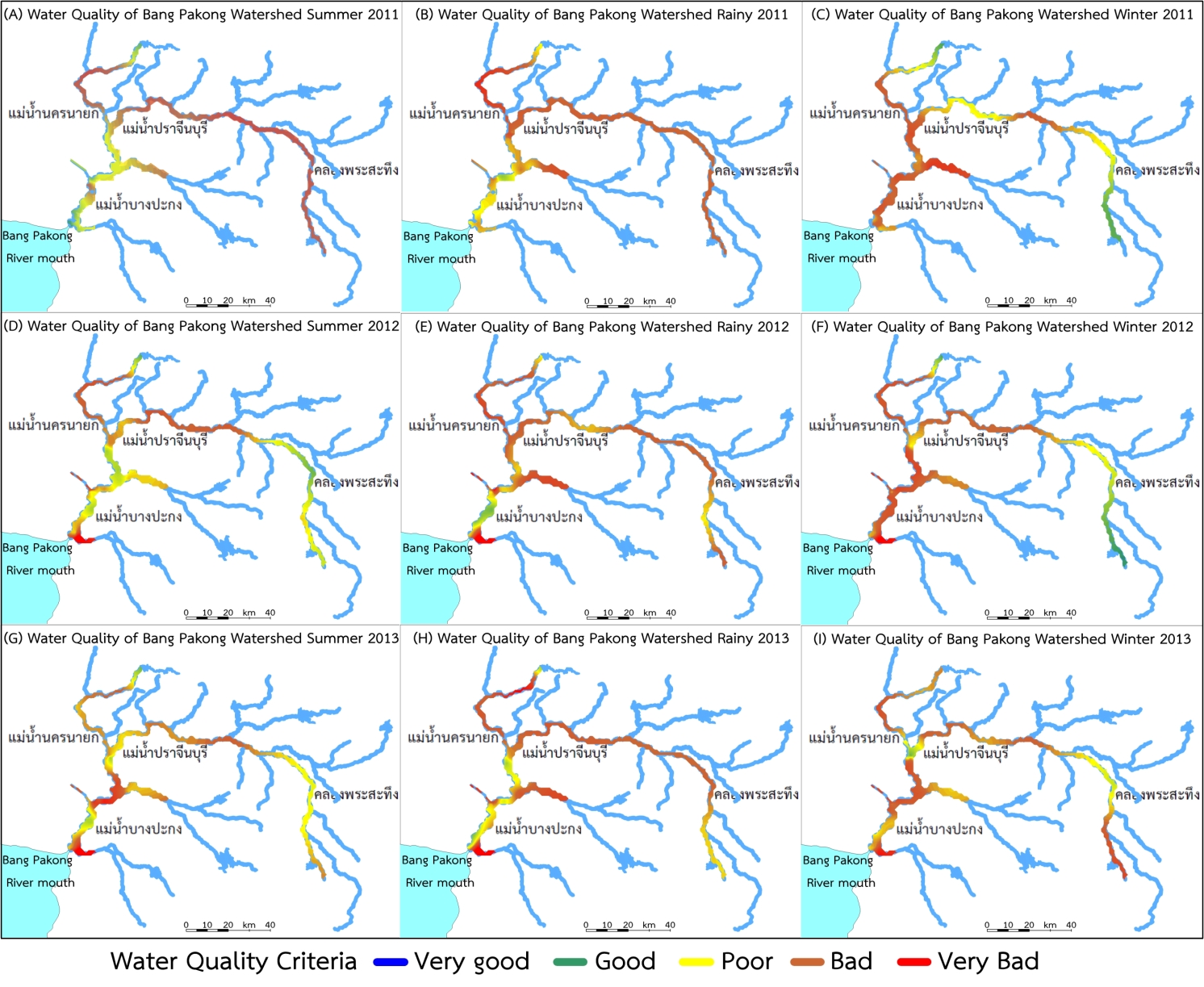
การประเมินคุณภาพน้ำตามฤดูกาลในลุ่มน้ำสาขาของลุ่มน้ำบางปะกงในรอบปี พ.ศ. 2554–2556 ด้วยวิธีดัชนีคุณภาพน้ำในแหล่งน้ำผิวดิน (WQI) และดัชนีมลพิษทางน้ำ (WPI5) พบว่า ไนเทรตละลาย (dissolved nitrate) มีค่าตามเกณฑ์มาตรฐานคุณภาพน้ำผิวดินในทุกฤดู ปริมาณออกซิเจนละลาย (DO) เกือบทั้งหมดมีค่าต่ำกว่าเกณฑ์มาตรฐานคุณภาพน้ำ ในขณะที่ความต้องการออกซิเจนทางชีวภาพ (BOD) แอมโมเนียละลาย (NH3–N) แบคทีเรียกลุ่มโคลิฟอร์มทั้งหมด (TCB) และแบคทีเรียกลุ่มฟีคอลโคลิฟอร์ม FCB มีค่าสูงกว่าเกณฑ์มาตรฐานคุณภาพน้ำในทุกฤดู การประเมินคุณภาพน้ำผิวดินและการปนเปื้อนเชิงพื้นที่ในลุ่มน้ำบางปะกงในรอบปี พ.ศ. 2554 แสดงว่าน้ำมีคุณภาพเสื่อมโทรมหรือมีการปนเปื้อนในฤดูร้อน มีคุณภาพเสื่อมโทรมมากและปนเปื้อนมากในฤดูฝน และน้ำมีคุณภาพดีขึ้นในฤดูหนาวซึ่งสอดคล้องกับค่า DO น้อย และ TCB และ FCB มาก ส่วนในรอบปี พ.ศ. 2555 น้ำยังคงมีคุณภาพเสื่อมโทรมมากหรือมีมลพิษมากขึ้นในลุ่มน้ำสาขาแม่น้ำปราจีนบุรี ลุ่มน้ำสาขาที่ราบบางปะกงส่วนที่ 1 และลุ่มน้ำสาขาที่ราบบางปะกงส่วนที่ 2 มากกว่าปีที่ผ่านมา และมีคุณภาพดีขึ้นในฤดูหนาว และสุดท้ายในปี พ.ศ. 2556 พบว่าน้ำในลุ่มน้ำบางปะกงมีคุณภาพดีขึ้นเล็กน้อยในฤดูร้อน และมีคุณภาพเสื่อมโทรมมากขึ้นและการปนเปื้อนมลพิษมากขึ้นอีกในฤดูฝน แล้วจึงกลับมามีคุณภาพดีขึ้นหรือมีการปนเปื้อนมลพิษในน้ำน้อยลงในฤดูหนาว สอดคล้องกับช่วงเวลาที่พื้นที่ลุ่มน้ำบางปะกงได้รับอิทธิพลของพายุ GAEMI ทำให้เกิดน้ำป่าไหลหลากและน้ำท่วมฉับพลันในช่วงระหว่างเดือนกันยายนถึงเดือนตุลาคม พ.ศ. 2555 และน้ำท่วมพื้นที่ลุ่มน้ำบางปะกงในช่วงฤดูฝนในปี พ.ศ. 2556 ที่อาจพาสารอาหารจากพื้นที่เกษตรกรรม ปศุสัตว์ และสิ่งปฏิกูลจากชุมชนลงสู่ลุ่มน้ำบางปะกง ส่งผลให้คุณภาพน้ำมี DO ต่ำ ในขณะที่พบ BOD NH3–N TCB และ FCB มีค่าสูง คะแนนดัชนีคุณภาพน้ำในแหล่งน้ำผิวดิน (WQI) และคะแนนดัชนีมลพิษทางน้ำ (WPI5) ในลุ่มน้ำบางปะกงมีความสัมพันธ์กันเชิงลบในฤดูร้อน ปี พ.ศ. 2554 และ 2555 โดยมีค่าสัมประสิทธิ์การตัดสินใจ (R2) 0.5598 และ 0.5609 อย่างไรก็ตามการย่อยสลายในลุ่มน้ำจากกิจกรรมการเพาะเลี้ยงสัตว์สามารถใช้ได้ง่ายกับดัชนีคุณภาพน้ำในแหล่งน้ำผิวดิน (WQI) และสามารถใช้ดัชนีมลพิษทางน้ำ (WPI5) ประเมินคุณภาพมลพิษทางน้ำที่หลากหลายมากกว่าผลการประเมินคุณภาพน้ำด้วยวิธีนี้อาจใช้สำหรับการประเมินประสิทธิภาพการใช้น้ำและสิ่งแวดล้อมในเชิงวิทยาศาสตร์ มูลค่าความเสียหายในทางเศรษฐศาสตร์จากปัญหาคุณภาพน้ำเสื่อมโทรม รวมทั้งอาจใช้เป็นข้อมูลในการบริหารจัดการน้ำในลุ่มน้ำบางปะกงได้ต่อไป
คำสำคัญ: ดัชนีคุณภาพน้ำ ดัชนีมลพิษ ลุ่มน้ำบางปะกง
Abstract
The seasonal water quality assessment in the tributaries of the Bang Pakong river basin during 2011–2013 using the surface water quality index (WQI) and water pollution index (WPI5) found that dissolved nitrate was in accordance with the surface water quality standards in every season. Almost all dissolved oxygen (DO) was lower than the water quality standards, while the biological oxygen demand (BOD), dissolved ammonia (NH3–N), total coliform bacteria (TCB), and fecal coliform bacteria (FCB) were higher than the water quality standards in every season. The spatial assessment of surface water quality and contamination in the Bang Pakong basin in 2011 showed that the water quality was deteriorated or contaminated in summer, and very deteriorated and highly contaminated in the rainy season, and the water quality was better in winter, which was consistent with low DO and high TCB and FCB. In 2012, the water quality was still much deteriorated or more polluted in the Prachin Buri river tributaries, the Bang Pakong plain tributaries Part 1, and the Bang Pakong Plain tributaries Part 2, more than the previous year, and the quality was better in winter. Finally, in 2013, the water quality in the Bang Pakong basin was slightly better in summer, then deteriorated and more polluted in the rainy season, and returned to better quality or less polluted in winter. This is consistent with the period when the Bang Pakong basin was affected by the GAEMI storm, causing flash floods and mudslides during September to October 2012 and flooding in the Bang Pakong basin during the rainy season of 2013, which may have carried nutrients from agricultural areas, livestock and community waste flow into the Bang Pakong Watershed, resulting in low DO in water and high values of BOD, NH3–N, TCB and FCB. The score of surface water quality index (WQI) and water pollution index (WPI5) in the Bang Pakong river basin were negatively correlated in summer 2011 and 2012, with coefficients of determination (R2) of 0.5598 and 0.5609, respectively. However, watershed degradation from aquaculture activities can be easily applied to this water quality index (WQI) and the water pollution index (WPI) can be used to assess a wider range of water pollution conditions. The results of this water quality assessment may be used as a basis for scientific assessment of water use efficiency and environment, economic damages from water quality deterioration, and may also be used as information for water management in the Bang Pakong river basin.
Keywords: Bang Pakong watershed, Water pollution index, Water quality index
Downloads
Article Details

This work is licensed under a Creative Commons Attribution-NonCommercial 4.0 International License.
References
Ahmed, T., Zounemat–Kermani, M., and Scholz, M. (2020). Climate change, water quality and water–related challenges: A review with focus on Pakistan. International Journal of Environmental Research and Public Health 17(22): 8518.
Announcement of the National Environment Board No. 8 (2537 B.E.) the determination of water quality standards in surface water sources. (February 24, 1994). Royal Gazette. 111 (Section 16 D): 234–240. (in Thai)
Asdecon Corporation Co., Ltd. (2012). The Operation of Data Collection and Data Analysis, the 25 Watershed Information Data System Development Project and Flood Model. Hydro and Agro Informatics Institute (HAII).
Environment and Pollution Control Office 13 (Chonburi). (2019). Water Quality Monitoring Report in Surface Water Source (River and Branch Canal) Eastern Region. Chonburi: Author.
Environment and Pollution Control Office 7 (Saraburi). (2017). Water Quality Situation Report in the Area of the EPCO. 7 (Saraburi). Saraburi: Author.
Graf, W. L. (1975). A cumulative stream–ordering system. Geographical Analysis 7(3): 335-340.
Hossain, M., and Patra, P. K. (2020). Water pollution index – A new integrated ap-proach to rank water quality. Ecological Indicators 117(106668): 1–9.
Krue–hom, D., and Kwanyuen, B. (2017). The study of flood characteristic in Bangpakong–Prachinburi River Basin. Veridian E–Journal, Science and Technology Silpakorn University 4(3): 70–100.
Pollution Control Department. (2015). Total Score Value of 5 Water Quality Parameters (New WQI Calculation). Fresh Water Sources Water Quality Management Office, Ministry of Natural Resources and Environment.
Popovic, N. Z., Duknic, J. A., Atlagic, J. Z., Rakovic, M. J., Marinkovic, N. S., Tubic, B. P., and Paunovic, M. M. (2016). Application of the water pollution index in the assessment of the ecological status of rivers: a case study of the Sava River, Serbia. Acta Zoologica Bulgarica 68(1): 97–102.
Rice, E. W., Baird, R. B., and Eaton, A. D. (2017). Standard Methods for the Examination of Water and Wastewater 23rd ed. USA: American Public Health Association, American Water Works Association, Water Environment Federation.
Royal Decree–Law Defining River Basins 2021. (February 11, 2021). Royal Gazette. Vol. 138, Chapter 12A. (pp. 1–53). Bangkok: Government Gazette. (in Thai)
Royal Irrigation Department. (2018). Project Opinion Report about How to Measure Water Quality. Bangkok: Water Quality Improvement Working Group, Royal Irrigation Department.
Scheidegger, A. E. (1968). Horton’s Law of Stream Numbers. Water Resources Article 4(3): 655–658.
Simoes, F. S., Moreira, A. B., Bisinoti, M. C., Gimenez, S. M. N., Josefa, M., and Yabe, M. J. S. (2008). Water quality index as a simple indicator of aquaculture effects on aquatic bodies. Journals Ecological Indicators 8(5): 476–484.
Thai Meteorological Department. (2025). Natural Disaster Report in Thailand. Retrieved from http://climate.tmd.go.th/disaster/content?lang=enandpage=122, January 9, 2025. (in Thai)
The Secretariat of the Cabinet. (2000). The Register of Wetlands of International and National Importance in Thailand and Measures for Wetlands Conservation. Bangkok: Office of Natural Resources and Environmental Policy and Planning. (in Thai)
Water Quality Report. (2018). Water Quality Database System Environmental Office Region 1–16, Phase 2. Retrieved from https://rwater.mnre.go.th/front/main/WaterQuality, January 9, 2025 (in Thai)
Whitehead, P. G., Wilby, R. L., Battarbee, R. W., Kernan, M., and Wade, A. J. (2009). A review of the potential impacts of climate change on surface water quality. Hydrological Sciences–Journal–des Sciences Hydrologiques 54(1): 101–123.